Vibration Resilience: Protecting Helicopter Maintenance and Cockpit Lighting from Rotor Shock

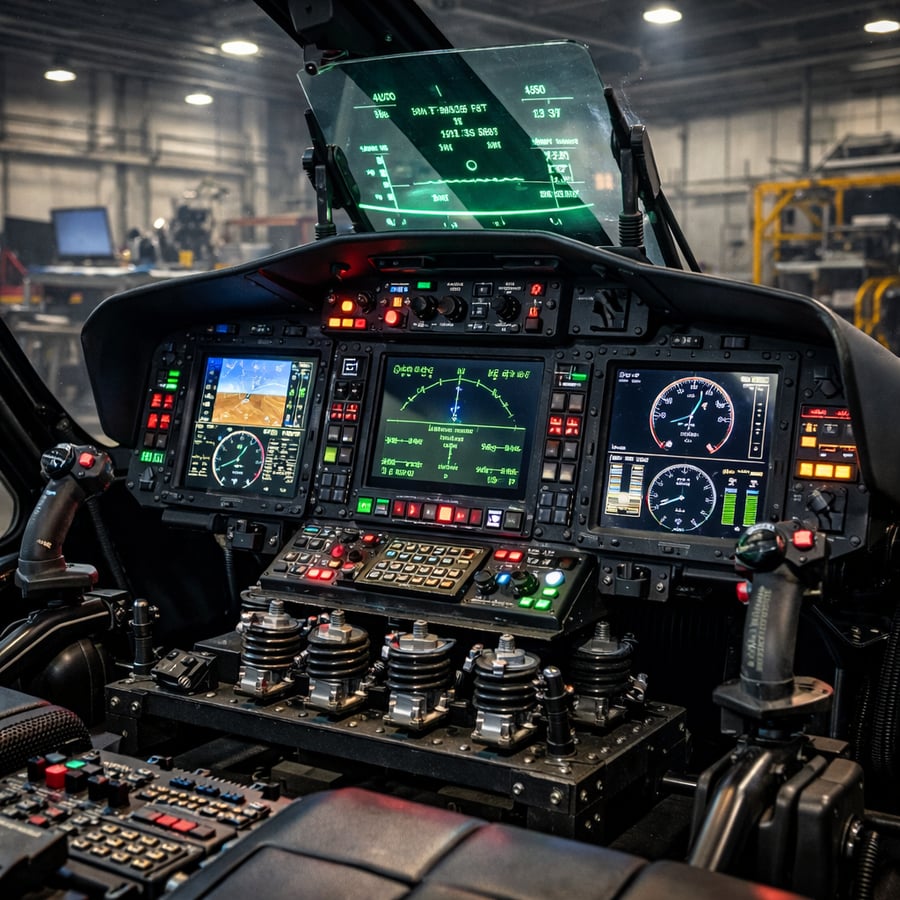
Few mechanical environments are as punishing as a helicopter airframe. The immense lift and thrust generated by main and tail rotors create a non-stop barrage of high-energy, low-frequency harmonics mixed with intense, multi-directional transient shocks. For aviation engineers and maintenance crews, this vibration isn’t just a comfort issue—it is an operational hazard.
Left unmitigated, relentless rotor shock causes rapid wire-filament fatigue in cockpit lighting, destabilizes delicate heads-up displays (HUDs), and causes sensitive avionics arrays to drift out of calibration. On the ground, trying to perform precision maintenance or boresight testing while auxiliary power units (APUs) or neighboring rotors are spinning can severely compromise accuracy.
To safeguard these mission-critical systems, aerospace and defense engineers must move past generic catalog components. True survivability requires a deeply analyzed, engineered solution. At Sunnex, our strategic partnership with Vibrostop® (an Anamplex Group Company) provides the precise finite modeling needed to isolate helicopter infrastructure from the flight deck to the maintenance bay.
The Chaos of Rotor Harmonics: Why Standard Mounts Fail
In standard industrial applications, machinery vibration is relatively predictable and unidirectional. Aerospace environments tear up that rulebook. A helicopter rotor assembly generates complex dynamic stresses that travel through the airframe simultaneously across multiple planes:
- Multi-Axis Transient Shock: Hard landings, sudden tactical maneuvers, and aerodynamic turbulence subject internal components to high G-force spikes across the compression, tension, and shear axes.
- High-Frequency Resonances: The fast-spinning components of avionics cooling fans and main rotor shafts produce high-frequency vibrations that can instantly fracture delicate solder joints and extinguish critical cockpit indicators.
- Severe Flight Environments: Hardware must endure wild temperature swings, ozone exposure, and salt-heavy marine environments during naval deployments without losing its dampening properties.
A generic off-the-shelf rubber pad cannot dynamically adapt to these rapid, chaotic shifts. Without predictive engineering, standard mounts either bottom out under high G-forces or fail to isolate the specific destructive frequencies unique to the helicopter's rotor profile.
The Power of Finite Modeling in Aerospace and Defense
When failure carries mission-level consequences, guessing is not an option. Sunnex can utilize mathematical finite modeling to eliminate the vulnerabilities of trial-and-error component picking. Before a single mount is deployed into a military cockpit or hangar facility, our engineering team can map the application requirement and make recommendation on the proper solution for the application.
Through comprehensive physical assessments and validation within our specialized laboratory, we can simulate how different dampening mediums respond to high-G impacts and continuous harmonic resonance. If a cockpit light fixture requires an isolation mount with high deflection under a very small weight load, we can model elastomeric compound properties—testing hardness, tensile strength, and tear resistance—to ensure the component can survive millions of flight cycles without degradation.
Tailored Isolation Solutions for Flight and Ground Operations
Mitigating the sheer diversity of aviation shock requires a strategic mix of high-performance isolator technologies:
1. Multi-Directional Cable Isolators for Avionics and Cockpit Lighting
For cockpit instrumentation, control boxes, and flight-deck lighting systems, traditional single-axis rubber mounts pose an immediate risk during high-G maneuvers. Multi-directional wire rope and cable isolators provide uniform energy absorption across all axes. They handle simultaneous tension, shear, and compression, making them perfect for protecting delicate electronic components from the violent vibrations of the main rotor assembly.
2. High-Deflection Elastomeric Mounts for Sensitive Equipment
When isolating low-load, high-frequency components like cockpit cockpit indicators or specialized optical sensors, the dampening medium must provide high deflection under minimal weight. Using compact, aerospace-grade elastomeric mounts (such as the Conic or Superflex series) allows for exceptional vibration dampening at low frequencies while maintaining a microscopic vertical footprint.
3. Rugged Ground Support and Maintenance Bay Dampers
Vibration resilience is just as critical on the hangar floor as it is in the air. Heavy ground support infrastructure, diagnostic calibration benches, and engine test stands must be completely isolated from surrounding environmental vibrations. Utilizing heavy-duty, slip-resistant elastomeric dampers (such as the Vibrostop TSZ or BPD series) provides high load capacities up to 44,000 lbs alongside built-in anti-tilt safety mechanisms to ensure that maintenance operations remain steady, safe, and precise.
The Sunnex Advantage: Over 80 Years of Defense-Grade Precision
In the aerospace and defense sector, implementing elite vibration control is directly tied to operational readiness, equipment reliability, and personnel safety. Preventing premature component failures translates directly to fewer emergency maintenance turnarounds, lowered system lifetimes costs, and maximum fleet availability.
By partnering with Sunnex, you leverage over 80 years of rigorous research and development, strict adherence to UNI EN ISO 9001 and UNI EN 9100 aerospace quality standards, and an extended 5-year warranty on metallic components.
Protect your critical flight systems from the destructive realities of rotor shock. Contact our technical engineering team today to receive a complete application assessment and a custom-modeled solution designed to endure the toughest environments on earth and above it.