Beyond the Data Sheet: Why Finite Modeling is Crucial for Complex HVAC Vibration Isolation

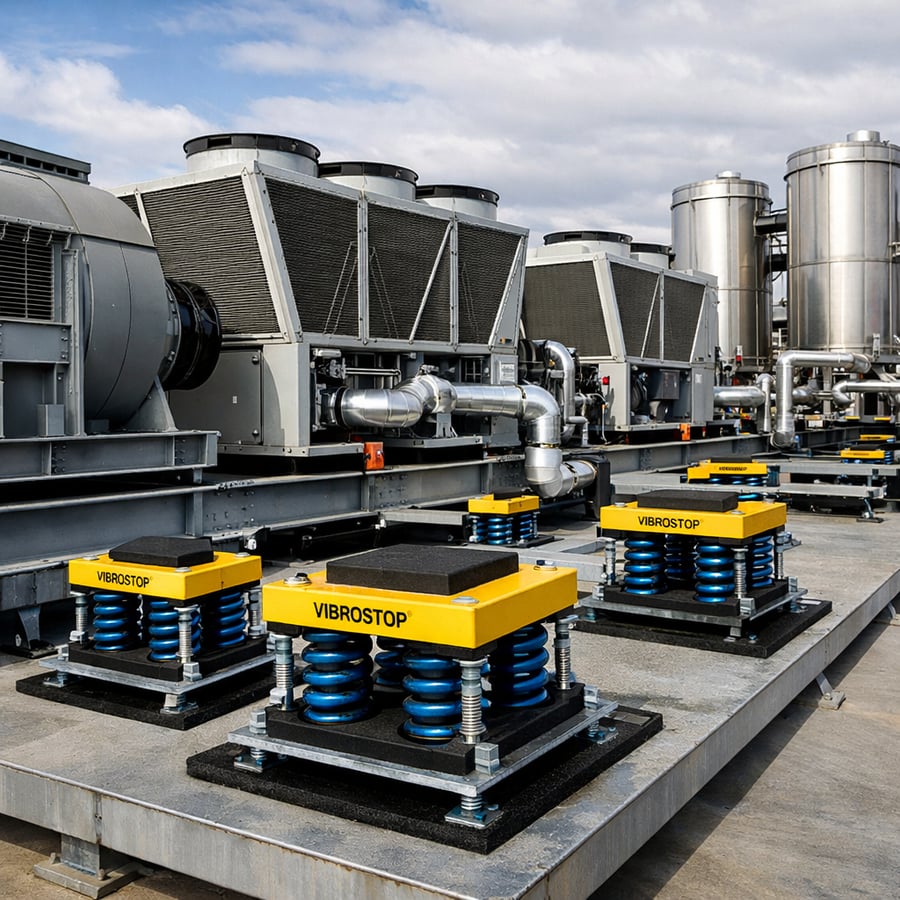
Every experienced HVAC engineer has been there: you look at the static load requirements for a heavy-duty chiller or rooftop air handling unit (AHU), cross-reference a manufacturer’s catalog data sheet, select a matching rubber pad or spring mount, and mark the job done.
On paper, the numbers match. In reality? The building's top floor is humming with structure-borne noise, or worse, the mounts begin to degrade prematurely under dynamic, multi-axis stresses.
When dealing with high-performance modern climate control systems, static load ratings tell only half the story. To achieve true environmental comfort and guarantee the equipment’s full operational lifetime, engineering teams must move beyond the data sheet and embrace predictive finite modeling. At Sunnex, our partnership with Vibrostop® (an Anamplex Group Company) shifts the focus from simple component sourcing to comprehensive HVAC Solutions.
Why Off-the-Shelf Data Sheets Fail Complex Harmonics
A standard product data sheet is a simplified map of an incredibly complex environment. It typically provides a maximum weight rating and a single vertical deflection rate. However, real-world industrial HVAC equipment doesn't just push straight down.
Equipment like cooling towers, heavy reciprocating compressors, and high-velocity inline fans generate complex, multi-directional forces:
- Dynamic Harmonics: Rotational machinery creates continuous structural vibrations that travel through rigid piping networks and building frames.
- Multi-Axis Stresses: System start-ups, wind loads, and thermal shifts subject mounts to concurrent compression, tension, and shear stresses.
- Environmental Aging: Factors like ozone exposure, freezing outdoor temperatures, and salt-heavy coastal air alter the physical performance of elastomeric compounds over time.
If your isolation strategy is based solely on static data sheets, it cannot account for how a mount will behave when these forces collide.
The Science of Predictive Performance: What is Finite Modeling?
Finite modeling takes the guesswork out of vibration and shock isolation. Instead of guessing how a hardware component might perform, our engineering team can make recommendations on the correct solutions based on years of experience and theoretical modeling system application before any hardware is installed.
Vibrostop product design benefit from decades of expert mathematical modeling and in-house laboratory validation.This allows us to map exactly how an anti-vibration device will handle real stress. For example, if a custom compound mixture is required for an extreme environment, finite modeling allows us to simulate its performance criteria—such as tensile strength, tear resistance, and hardness—long before the manufacturing phase.
Engineering the Right Solution for Every Sub-Vertical
Because different HVAC applications produce completely unique acoustic and mechanical frequencies, a one-size-fits-all product strategy is fundamentally flawed. Effective mitigation requires selecting the proper category of isolator based on modeling data:
1. Low-Frequency Spring Mounts for Heavy-Duty Machinery
Large-scale mechanical systems such as chillers, rooftop AHUs, and large compressors generate low-frequency vibrations that easily travel through concrete slabs. For these applications, off-the-shelf rubber blocks aren't enough. Engineers look to solutions like the Vibrostop MOPLA series, which offer low suspension frequencies and expansive deflection limits to completely isolate severe structure-borne noise. Where extreme structural shifts or weather events are a factor, integrated anti-tilt mechanisms and specialized seismic restraint configurations ensure heavy machinery stays safely anchored.
2. Multi-Directional Cable Isolators for Complex Dynamic Loads
When equipment is subjected to unpredictable lateral movements, high transient shock, or multi-axis forces, standard single-axis mounts risk sudden failure. Multi-directional cable isolators absorb energy uniformly across all planes. This versatility makes them excellent choices for stabilizing sensitive electrical control enclosures, protecting precision equipment in server rooms, or handling fluctuating fluid dynamics in heavy piping loops.
3. Elastomeric Dampers for High-Frequency and Overhead Hangs
Not every challenge is down on the floor. Suspended equipment like exhaust fans, boilers, and overhead water ducts transmit persistent high-frequency noise directly into a building's framework. Utilizing compact rubber dampers or specialized ceiling hanger mounts (such as the Mohang or Silentfix lines) stops high-frequency transmission in its tracks without taking up valuable vertical space or complicating installation times.
The Sunnex Advantage: Over 80 Years of R&D Expertise
Investing in premium vibration control isn't just about avoiding occupant complaints; it’s about asset protection. Unmitigated vibration accelerates mechanical fatigue, loosens pipe connections, and triggers premature equipment failures—leading to expensive service turnarounds and system downtime.
By choosing Sunnex as your engineering collaborator, you gain access to a heritage of quality backed by over 80 years of specialized R&D, rigorous UNI EN ISO 9001 quality certifications, and an extended 5-year warranty on metallic components.
Don't leave your structural integrity up to a basic product sheet. Let our technical team perform an accurate application assessment to configure an optimized, long-lasting solution tailored specifically to your project's unique demands.