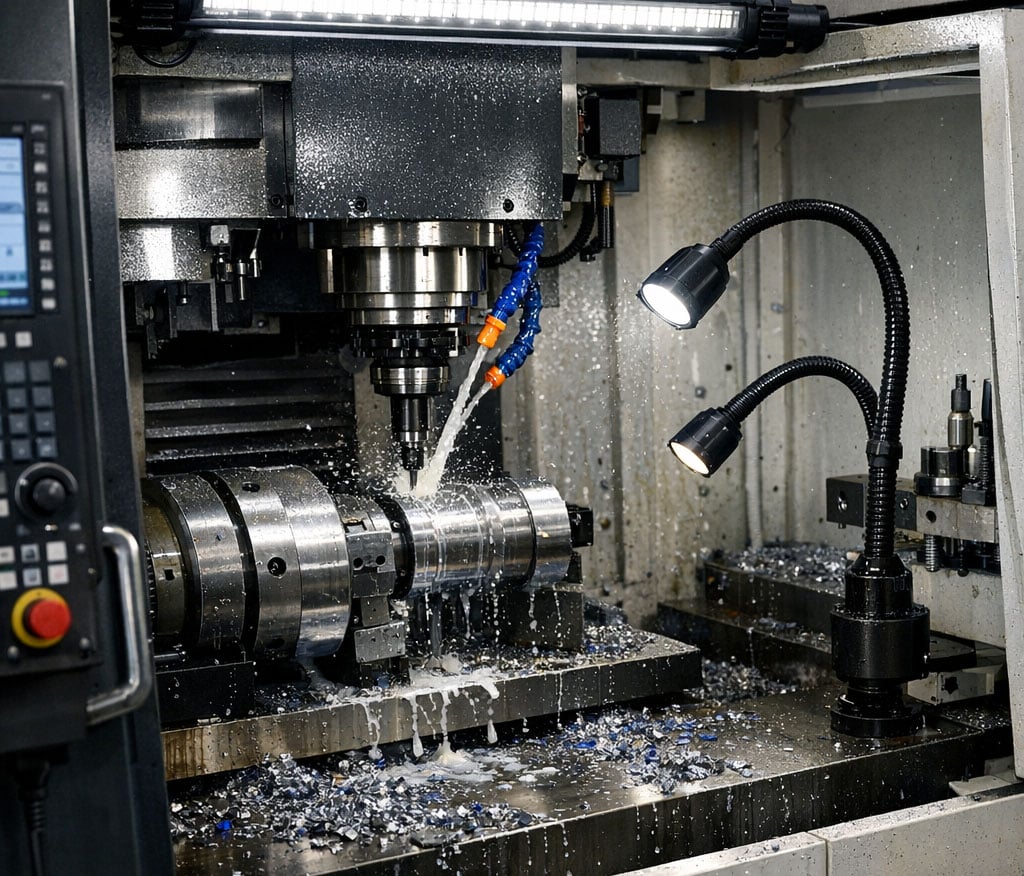
Every factory floor presents a different combination of airborne dust, coolant mist, vibration, and heat. When an industrial LED task light is not matched to those specific conditions, its components degrade faster than expected, and operators lose the visual clarity they need for precision work.
Understanding how ingress protection (IP) ratings and mounting design influence reliability helps you specify the right fixture from the start. This article explains the environmental factors behind premature LED task light failure and shows you how to evaluate IP ratings and mounting stability before you commit to a fixture.
Key Takeaways
- IP ratings define a fixture's tested resistance to dust and water, directly affecting its operational lifespan.
- Vibration from nearby machinery loosens electrical connections and accelerates component wear over time.
- Moisture ingress causes corrosion of internal circuitry, reducing light output and triggering early failure.
- Heat buildup from blocked ventilation or poor thermal design shortens LED driver life significantly.
- Sunnex LED task lights combine IP65 protection with rugged aluminum housings for reliable factory performance.
What Is an IP Rating and Why Does It Matter for Task Lights?
IP stands for Ingress Protection, a classification defined by IEC standard 60529. The rating uses two digits. The first digit (0 to 6) indicates protection against solid particles such as dust and metal shavings. The second digit (0 to 9) measures protection against liquids, including water jets and coolant spray.
For industrial task lights, this rating tells you exactly how well the fixture seals its internal electronics against the contaminants present in your facility. A light rated IP20 offers minimal protection, while a light rated IP65 is completely dust-tight and withstands low-pressure water jets from any direction.
Choosing a task light without checking the IP rating is a common source of premature failure. If coolant mist or metal dust penetrates the housing, it corrodes circuit boards and degrades the LED driver, reducing both output and lifespan.
How Dust and Particulate Matter Cause LED Task Light Failure
Dust is present in virtually every manufacturing facility. Grinding, machining, woodworking, and material handling all generate fine particles that become airborne and settle on every exposed surface, including lighting fixtures.
When dust accumulates on or inside a task light, it traps heat against critical components. Even modest temperature increases above the designed thermal range can accelerate LED degradation and shorten driver life. Facilities handling materials like grain, pigments, carbon fiber, or metal powders experience particularly rapid buildup.
A fixture rated IP6X (where the first digit is 6) is classified as dust-tight, meaning no dust enters the enclosure under test conditions. For environments with heavy particulate exposure, specifying anything lower than IP6X introduces a measurable reliability risk. The Sunnex SL 6 carries an IP65 rating, providing full dust protection for demanding applications such as grinding and lathe operations.
Why Moisture and Coolant Exposure Degrade Lighting Components
Coolant spray, washdown procedures, and ambient humidity are standard conditions in many factories. When moisture reaches the interior of a task light, it creates conductive pathways across circuit boards that can cause short circuits. Over time, even low levels of moisture promote corrosion on metal contacts and solder joints.
The second digit of the IP rating addresses this risk directly. An IPX5 rating means the fixture has been tested against water jets projected from all directions at a prescribed flow rate and pressure. For environments with regular coolant exposure, an IP65 or higher rating is the minimum responsible specification.
Fixtures without adequate moisture protection often show a decline in light output months before they fail completely. By the time you notice a dim fixture, internal corrosion has already compromised the driver and LED array.
How Vibration and Mounting Design Affect Long-Term Reliability
Continuous vibration from motors, conveyors, CNC machines, and presses puts constant mechanical stress on every component attached to or near the equipment. For LED task lights, this stress manifests as loosened electrical connections, degraded solder joints, and cracked circuit boards.
Mounting design is just as important as the IP rating. A fixture secured with a rigid bracket on a vibrating machine transfers every oscillation directly into the light's housing. Over weeks and months, this repeated stress causes intermittent flickering and eventual failure of the LED driver.
Sunnex addresses this challenge with flexible gooseneck arms and rugged aluminum lamp heads engineered to absorb vibration rather than transmit it. The Sunmach 10, for example, pairs IP65 dust and water protection with a vibration-resistant arm and durable aluminum housing built for machining environments.
The Role of Heat Management in LED Task Light Longevity
LEDs generate less heat than halogen or fluorescent alternatives, but they are not immune to thermal stress. When a task light operates in a high-ambient-temperature environment near furnaces, injection molding equipment, or welding stations, internal temperatures can exceed the rated range of the driver and LED array.
Poor thermal design traps heat inside the fixture housing. Accumulated dust compounds the problem by insulating components and blocking the heat dissipation pathways. The result is accelerated lumen depreciation, where light output gradually declines well before the rated service life is reached.
Aluminum lamp heads, like those used across the Sunnex Luxor and Sunmach 10 product lines, act as heat sinks that draw thermal energy away from LEDs and drivers. This design choice directly extends fixture life in elevated-temperature environments.
How to Evaluate IP Ratings When Specifying Task Lights
Matching the IP rating to your specific environment requires an honest assessment of the conditions your fixtures will face daily. Consider these factors during the specification process:
- Particulate type and density: Metalworking, woodworking, and food processing each generate different particle sizes and volumes. Heavy dust environments demand a first digit of 6 (dust-tight).
- Liquid exposure: Identify whether your fixtures will encounter coolant mist, direct water jets, or high-humidity condensation. Each requires a different second digit.
- Vibration intensity: Map the vibration sources near each planned light location. High-vibration zones need fixtures with tested vibration resistance and flexible mounting arms.
- Ambient temperature range: Confirm that the fixture's rated operating temperature exceeds the actual conditions in your facility, including radiant heat from nearby equipment.
Sunnex offers direct application consultation to help you match the right IP rating and mounting configuration to your specific factory conditions.
Comparing IP Ratings Across Common Industrial Applications
This table provides a starting point. Your actual conditions may require a higher rating depending on proximity to liquid sources, airflow patterns, and cleaning schedules. The Sunnex SL 3, available in IP65 versions, covers a broad range of industrial applications that require both dust and moisture resistance.
| Environment | Typical Hazards | Minimum IP Rating |
|---|---|---|
| CNC machining center | Coolant spray, metal chips, vibration | IP65 |
| Woodworking shop | Fine sawdust, moderate humidity | IP54 |
| Food processing line | Washdown water jets, chemical cleaners | IP65 or higher |
| Welding station | Sparks, metal particles, high heat | IP65 |
| General assembly bench | Light dust, low moisture | IP20 to IP44 |
Specifying the Right IP Rating Protects Your Investment
IP ratings and mounting design are not optional specifications for factory lighting. They are the primary factors that determine how long your LED task lights will last and how reliably they will perform. Dust, moisture, vibration, and heat are constant forces in industrial environments, and fixtures that are not engineered to withstand them will fail earlier than their rated lifespan suggests.
Sunnex builds LED task lights with IP65 protection, aluminum thermal management, and vibration-resistant flexible arms because these are the conditions our customers face every day. Reach out today if you need help matching a fixture to your specific environment.
Frequently Asked Questions
1. What does IP65 mean for an industrial LED task light?
IP65 means the fixture is completely dust-tight (first digit 6) and protected against low-pressure water jets from any direction (second digit 5). Sunnex IP65-rated task lights like the SL 6 and SL 9 are built for environments where coolant spray, metal dust, and washdown procedures are routine.
2. Can vibration cause an LED task light to fail prematurely?
Yes. Continuous vibration from motors, presses, and conveyors loosens electrical connections and degrades solder joints inside the fixture. Sunnex task lights use flexible gooseneck arms and aluminum housings designed to absorb mechanical stress rather than transmit it to internal components.
3. What factors should I evaluate when choosing an IP rating for my facility?
Assess your particulate density, liquid exposure type, vibration intensity near each light location, and ambient temperature range. Then match those conditions to the appropriate IP digits. Sunnex offers direct application consultation to help you specify the right fixture and mounting configuration for your exact conditions.